Understanding Rate of Perceived Exertion (RPE) in Powerlifting
If you’ve spent any time in a gym—especially around powerlifters—you’ve probably heard someone say, “That felt like an 8.” They’re not guessing. They’re using Rate of Perceived Exertion (RPE) – a powerful (and often misunderstood) tool in strength training.
What is RPE?
RPE stands for Rate of Perceived Exertion. It’s a scale from 1 to 10 that measures how hard you feel your body is working during physical activity. A key component to RPE is that it is subjective. This means that it’s based on how hard you feel you’re working, not just the weight on the barbell. RPE reflects your personal sense of effort, so your RPE may differ from someone lifting right beside you.
Most people already use RPE intuitively by adjusting effort based on how challenging something feels. However, because it’s self-reported, it can be misjudged. Beginners may overestimate their effort, while experienced lifters may underestimate and push closer to their limit than intended. However, used correctly RPE is a useful tool for estimating effort and guiding training intensity.
In powerlifting, RPE is often connected to Reps in Reserve (RIR). This means that RPE is used to measure how hard a set feels based on how many reps you have left in the tank. For example, RPE 10 = no reps left (max effort) RPE 9 = 1 rep left, RPE 8 = 2 reps left etc. While often used interchangeably, RPE can be broader as it also reflects how fast you are breathing, heart rate, how tired your muscles are and overall effort.
Why RPE Matters?
Another key factor of RPE is that it accounts for real-life considerations that affect performance such as sleep quality, stress levels, nutrition and muscle fatigue. A weight that felt like an RPE 7 last week might feel like a 9 today. RPE allows you to adjust in real time, making your training safer by not overtraining and more effective by allowing yourself to ramp up, maintain or slow down your fitness intensity for that day based on how you actually feel.
RPE in Powerlifting:
Powerlifting focuses on lifting heavy for low reps, so managing how hard you’re pushing matters. RPE helps you do that by giving you a simple way to check in with your body, avoid burning out, keep your form solid, build strength over time, and stay consistent—even on days when you’re not feeling 100%.
Tips for RPE:
RPE is a skill and like any skill, it improves with practice and time.
1) Film your lifts – check for speed and technique
2) Train with an experienced coach
3) Be honest and check in with yourself. Some days will feel heavier and that’s normal – adjust, be kind to yourself, and focus on consistency.
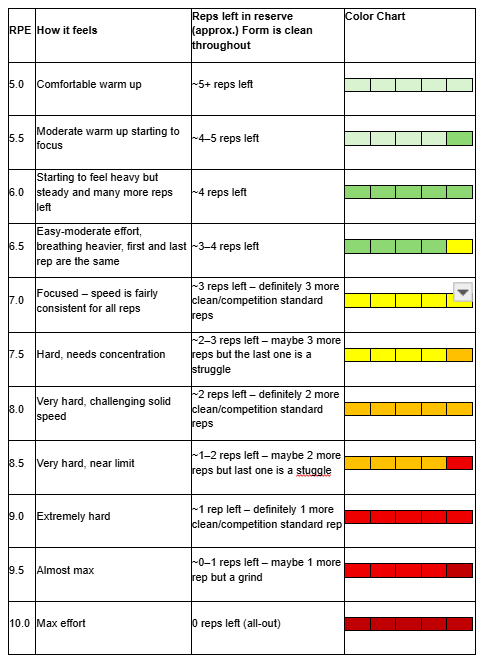
Rate of Perceived Exertion (RPE) chart by Coach Maya from Team Power Legion
References:
NASM – National Academy of Sports Medicine
ISSA – International Sport Sciences Association